

When Power Teaches Compassion
AMERICANS CREATING OUR OWN NEW DEALS

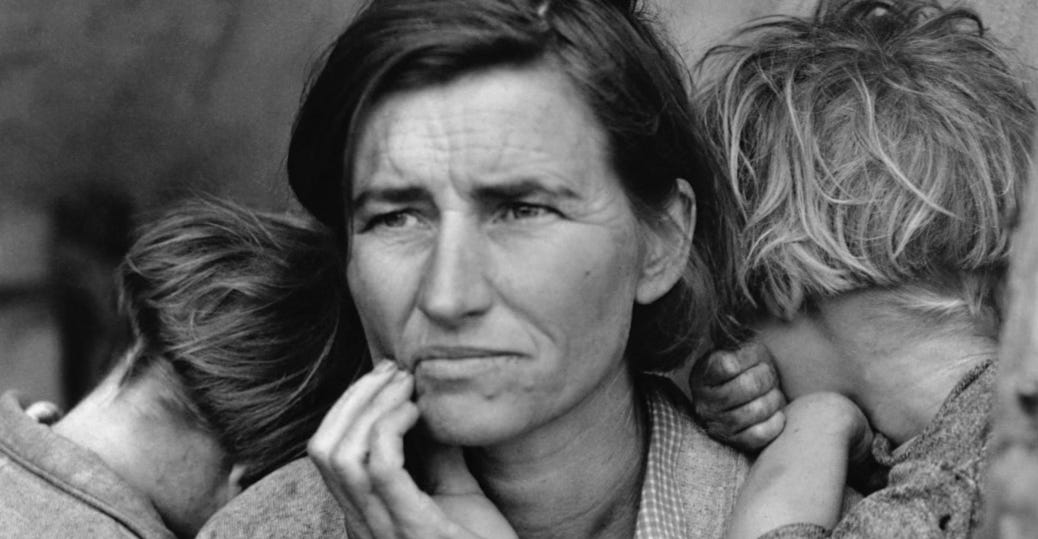
MIGRANT MOTHER | The Dustbowl Pictures | Dorothea Lange
THERE ARE SEASONS IN A NATION’S LIFE WHEN LESSONS ARRIVE IN UNEXPECTED FORMS.
We prefer to learn from heroes. We want examples of courage, generosity, and wisdom. We want leaders who show us how to be our better selves.
But history isn’t always so accommodating.
Sometimes we learn by witnessing the opposite.
In recent years, many Americans have watched government actions that strike them as unnecessarily harsh: cuts to housing assistance while luxury projects move forward; reductions in food, health, or social support programs while political allies benefit from contracts, tax advantages, or influence. Whether one agrees with every criticism or not, many people have experienced a growing sense that the vulnerable are being asked to bear burdens that the powerful can easily avoid.
The natural response is anger.
The understandable response is fear.
But there is another possibility.
Cruelty can clarify.
When we see a family losing rental assistance, we are reminded that housing isn’t an abstraction. It’s a child sleeping safely at night. It’s an elderly widow remaining in the apartment where she knows the neighbors. It’s stability, dignity, and belonging.
When we see food assistance reduced, we’re reminded that hunger isn’t a political talking point. It’s a human stomach. It’s a parent skipping dinner so a child can eat.
When we see programs for the poor, the disabled, or the elderly treated as expendable, we are reminded of a truth that many spiritual traditions have taught for centuries: a society reveals itself not by how it treats the powerful, but by how it treats those who possess little power at all.
Ironically, those who govern through indifference may end up teaching the rest of us something important.
They remind us of what we don’t wish to become.
This isn’t a call to passivity. Democracy requires engagement. Policies matter. Elections matter. Speaking honestly matters.
But there is a difference between resisting cruelty and becoming cruel ourselves.
The first strengthens a society.
The second merely changes the uniforms.
One of the great temptations of troubled times is to believe that outrage alone is a sufficient moral response. Yet outrage, left unattended, can harden into contempt. And contempt is remarkably adaptable. It can wear progressive clothes or conservative clothes. It can appear on television, in government, or on social media.
The antidote isn’t withdrawal.
It’s deliberate humanity.
The more coarse public life becomes, the more valuable kindness becomes.
The more leaders demean, the more important dignity becomes.
The more institutions fail to care for people, the more necessary it becomes that ordinary people care for one another.
History offers countless examples. During periods of political corruption, neighbors still helped neighbors. During eras of discrimination, ordinary citizens quietly sheltered the vulnerable. During wars, economic collapses, and social upheavals, countless unnamed people continued performing small acts of decency that never appeared in the headlines.
Civilizations survive because of those people.
Not because of the loudest voices.
Not because of the strongest rulers.
But because millions of ordinary individuals decide, day after day, that another person’s suffering matters.
Perhaps that is the hidden lesson of our age.
The cruelty we witness can either make us bitter or make us more compassionate.
The choice remains ours.
No administration can take that from us.
No politician can legislate it away.
No corruption can purchase it.
In every era, there are people who answer harshness with greater harshness. They become mirrors of the thing they oppose.
And then there are those who answer harshness with steadiness, courage, and care.
The future belongs to them.
It always has.
And maybe, in these difficult years, that’s exactly who we are being asked to become.